What happens when choro musicians get together in an informal setting? They play together and exchange experience regarding their instruments and playing technique. This is not 'small talk', not even among famous and well known musicians with a stellar career. Why not? Because choro is a serious thing that has to be refined to be kept alive at its best, all the time. Keeping this virtue in mind does not exclude 'having fun' and learning from each other, the result often is magic when the participating musicians 'cut loose' and just play for their own enjoyment to the benefit of the music. This is the way 'stardust' is generated, and how lucky we are to have the chance to have a view of such a meeting of the giants, who know their stuff inside out.
Recently the young bandolim player of the Choro das 3, Elisa Meyer, met with Hamilton de Holandaand Mike Marshall informally, the event luckily was recorded. The first video features Elisa and Hamilton
The second video from the same event features Elisa and Mike Marshall - enjoy!
This week Brazil is celebrating the centennial of singer, actress and moviestar, Carmen Miranda. - Maria do Carmo Miranda da Cunha was born on February 9, 1909, in Marco de Canavez, Portugal. Her familiy moved to Rio de Janeiro when she was about 2 years old. As a young woman she worked as a milliner. She was discovered at a talent show, and in 1929 she signed on with the Victor Recording Company.Her career was established throughout 1930s, she had success as a radio and recording artist, she was a star at the carnaval, became an actress taking part in movies and toured South America as a 'musical ambassador' for the Brazilian government. In 1939 she was offered a tour of the USA and with this step her second career was launched. Together with her Brazilian group of musicians, O Bando da Lua featuring Garoto, she was a sensation with the American public, and soon she was offered film work in Hollywood and, after moving to the USA, she became a celebrity and ranked among the highest paid artists in the country throughout the 1940s. She made several films in the USA, had success as an actress and also made recordings with her Bando da Lua, the first authentic Brazilian music including choros and sambas made digestable for an American audience. These recordings have since been reissued several times and are still worth listening to thanks to the charming voice of Carmen Miranda and the great accompaniment of her Banda do Lua.
Despite her official success with the public Carmen Miranda suffered from the stress as an Americanized Hollywood celebrity, she died of a heart attack on August the 5th, 1955. However, she'll forever be remembered as the prime icon of Brazilian music by the general public with little knowledge of the vast cultural heritage of Brazil. Carmen Miranda will remain 'The Lady with the tutti fruit hat' or the 'Brazilian Bombshell', so let's end this small commemoration enjoying Carmen in action with one of her greatest hits, 'Tico-tico no fúba', here in a sequence from her first Hollywood movie, 'Down Argentine Way' (1940):
Among the young generation of contemporary Brazilian artists devoting their talent and skills to choro, Danilo Brito stands out as an excellent example of a gifted musician, who knows his roots in the tradition and has contributed with splendid renditions of classic compositions by choro icons like Jacob do Bandolim, Chiquinha Gonzaga, Ernesto Nazareth and Pixinguinha as well as being a composer and arranger of his own material adding new dimensions to the choro standard repertoire.
Danilo Ezequiel Brito (b 1985) is from São Paulo, born into a musical family as the youngest of five children - his father, originally from the state of Paraíba in the Northeast of Brazil, was an active musician on the São Paulo music scene during the 1960s as a bandolimist. At an early age young Danilo started playing his father's bandolim and the cavaquinho, and it has been said that he at age five once surprised everyone by playing a sequence from the tune “Delicado”, by Waldir Azevedo, that he had learned on his own. At age eleven he lived for a year in Paraíba where he had the opportunity to improve his technique on both the bandolim and the cavaquinho, learning from friends of his family and having his debut in a live performance on a radio program. Back to São Paulo, he started to attend rodas de choro organized by various music shops dedicating his studies equally between the cavaquinho and the mandolin. He was still playing his father’s old bandolim when he got his first bandolim made by a luthier. From this point on, Danilo adopted the bandolim as his main instrument, always finding time to dedicate to it and to practice incessantly. Nevertheless, he never gave up playing the cavaquinho and he also started playing violão tenor. - Danilo was impressive not only because of his youth but also because of his superb technique with which he played valsas, choros, polkas, sambas and frevos. He began to receive invitations from celebrities and artists to perform and to give demonstrations of his talent and interviews to the press. He then started giving his first musical recitals on stage. The first time he played a solo performance was at UNIBAN (Bandeirantes University), along with the group Bachorando. Next step in his career was taken when he was offered the opportunity to record his first cd, shown above. The cd is a marvellous debut by a 13 year old kid supported by a classic choro ensemble, containing material by Jacob do Bandolim, Chiquinha Gonzaga a.o. besides a couple of examples of Danilo's own compositions. You may listen to the cd at full length on Rádio UOL by clicking here
In 2004 Danilo Brito entered and won the 7th annual VISA Awards for best instrumentalist on any instrument, one of the most important awards in Brazil – beating out 514 well-trained and skillful competitors. In winning the VISA Awards he gained the opportunity to record his secound cd, shown above. This second CD, entitled “Perambulando”, was released in 2005. Besides many traditional choro pieces, the CD contains some of his own compositions including the blistering "Sussuarana" as well as the title track. His tenor guitar work is featured on “Um Choro na Madrugada” and he has been highly praised for his interpretation of "Confidências", by choro pioneer Ernesto Nazareth. He is joined on several pieces by legendary musicians such as Altamiro Carrilho on flute, Toninho Ferragutti on accordion, and Nailor Profeta on clarinet. - The cd is still available and is highly recomended as a splendid example of Danilo Brito's great artistic skills.
Last year Danilo Brito recorded his third cd, "Sem Restrições", containing more examples of his own compositions as well as compositions by Alessandro Penezzi and Luperce Miranda. The cd was released in Brazil late 2008 and is available from online stores in Brazil, but I haven't had the opportunity to listen to it, yet. However, I found a filmed sequence from the live performance at the release concert, inserted below
Danilo Brito definitely belongs to the young heard of extraordinarily talented Brazilian musicians who deserve our full attention, he is a member of the masterclass of contemporary bandolimists like Hamilton de Holanda, Jorge Cardoso and Dudu Maia a.o.. I'm convinced that choro has a bright future ahead thanks to great talents like Danilo Brito. - Learn more about Danilo Brito from his official web (- in Portugues and English), click here
To end this small contribution I insert a couple of videos from a live performance in October 2008 featuring Danilo Brito and Rogério Caetano (violão 7 cordas) - here's a rendition of the classic choro "Espinha de Bacalhau"
Finally, here's the duo's interpretation of "Gostosinho" - enjoy!
Love to point you to a young all-round US guitar player, who is fascinated by Brazilian music: Daniel Volovets.
The tune Delicado, a Waldir Azevedocomposition, has been an inspiration for hunderds of guitar players all over the world. Jo wrote about this contribution Azevedolately.
Thanks to this blog contribution I was contacted by a young guitar player Daniel Volovets, 16 years old, who sent me his version of this popular Brazilian choro-tune, I love to share with you. Daniel Volovets lives in Minnesota (USA) and started to play the guitar at seven. Nowadays, ten years later, his repertoire contains classical guitar pieces, but also flamenco and Brazilian music. He studies the guitar with Anatoly Shapiro and Tony Hauser. The latter is well known for his interpretations of classical, flamenco, and Latin-American music. Now he's a student at the Minnesota University and the School of Music of Minnesota. Daniel Volovets, who is also an expert in video-games, like the Nintendo-games, released, despite his young age, two albums: Melodias Brasileiras and Watercolors of the World. I can't tell you anything about his first 2006 album ( Melodias Brasileiras ) ( and that's a pity of course as the title suggests some great music) but his latest one contains guitar pieces from all over the world; from Brazil, Spain, Russia, and Italy. Daniel Volovets is fascinated by the music of Antonio Carlos Jobim, Paco de Lucia and Hermeto Pascoal. On this 2008 Watercolors of the World you can find several tracks related to Brasil composed by Antonio Carlos Jobim, like Quiet Night of Quiet Stars, Luiza, Wave and the well known One-Note Samba. Other well known tunes on this album are Luiz Bonfa's Manha de Carnaval. Most tracks, dedicated to Brasil on this album are samba's and bossa novas, but there is one Choro tune, titled Sons de Carrilhoesa Joao Pernambucocomposition. If you click on that link you can hear a small fragment of it.
Love to share a fragment with you, although no Choro music, but a less known Carlos Jobim composition titled Andorinh and the well known Insensatez ( = How Insensitive ), also a well known jazz standard of the 1960s.
Waldir Azevedo(1923-1980) was a pioneer in exploring the cavaquinho as a solo instrument and he is considered one of the most successful choro musicians ever. He composed about 130 compositions in diverse genres, recorded extensively throughout his career and had success both in Brazil and internationally, performing in concerts and TV broadcasts worldwide. Azevedo started his solo career in 1949 recording the successful choro "Brasileirinho" for Continental/Todamerica, released January 1950. November 1950 he recorded his second smash hit, the baião "Delicado", released February 1951. I found an uploaded video on YouTube, which has the original soundtrack of "Delicado" - here from the Decca 45 rpm issue:
"Delicado" soon became a part of the standard repertoire with choro ensembles besides being exploited by the pop music industry through countless recordings that took advantage of the success of the original. I like the original the best, but I'm also thrilled when listening to contemporary renditions of the tune performed by devoted choro musicians - here's an example from a roda de choro featuring Grupo Cinco Companheiros with Paulão do Cavaco playing the solo as intended by Azevedo:
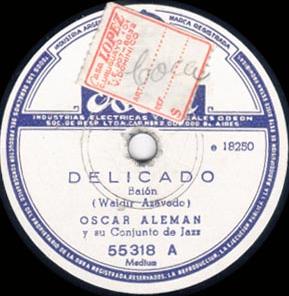
As mentioned above, countless versions of "Delicado" have been recorded since the release of the original in 1951 - one of my favorites is the guitar rendition by Oscar Alemán y su Conjunto from October 1951, a tribute from a master, who started his career playing the cavaquinho in the streets of Santos and ended up one of the best guitarists ever. Unfortunately, there is no filmed evidence of Alemán's incredible rendition of "Delicado", however, other guitarists have also transcribed the tune in a convincing arrangement - here's a contemporary example featuring a guitar quartet, Quarteto Abayomi, performing the tune straight:
I wish you a Happy New Year 2009/Feliz Ano Novo 2009! Jo