Daniel Volovets

Love to point you to a young all-round US guitar player, who is fascinated by Brazilian music: Daniel Volovets.

The tune Delicado, a Waldir Azevedo composition, has been an inspiration for hunderds of guitar players all over the world. Jo wrote about this contribution
Azevedo
lately.

Thanks to this blog contribution I was contacted by a young guitar player Daniel Volovets, 16 years old, who sent me his version of this popular Brazilian choro-tune, I love to share with you.

Daniel Volovets lives in Minnesota (USA) and started to play the guitar at seven. Nowadays, ten years later, his repertoire contains classical guitar pieces, but also flamenco and Brazilian music. He studies the guitar with Anatoly
Shapiro
and Tony Hauser. The latter is well known for his interpretations of classical, flamenco, and Latin-American music. Now he's a student at the Minnesota University and the School of Music of Minnesota.

Daniel Volovets, who is also an expert in video-games, like the Nintendo-games, released, despite his young age, two albums: Melodias Brasileiras and Watercolors of the World. I can't tell you anything about his first 2006 album ( Melodias Brasileiras ) ( and that's a pity of course as the title suggests some great music) but his latest one contains guitar pieces from all over the world; from Brazil, Spain, Russia, and Italy. Daniel Volovets is fascinated by the music of Antonio Carlos Jobim, Paco de Lucia and Hermeto Pascoal. On this 2008 Watercolors of the World you can find several tracks related to Brasil composed by Antonio Carlos Jobim, like Quiet Night of Quiet Stars, Luiza, Wave and the well known One-Note Samba. Other well known tunes on this album are Luiz Bonfa's Manha de Carnaval. Most tracks, dedicated to Brasil on this album are samba's and bossa novas, but there is one Choro tune, titled Sons de Carrilhoes a Joao Pernambuco composition. If you click on that link you can hear a small fragment of it.

Love to share a fragment with you, although no Choro music, but a less known Carlos Jobim composition titled Andorinh and the well known Insensatez ( = How Insensitive ), also a well known jazz standard of the 1960s.

Keep swinging

Hans Koert

keepswinging@live.nl

http://www.myspace.com/hanskoert

Delicado

Waldir Azevedo (1923-1980) was a pioneer in exploring the cavaquinho as a solo instrument and he is considered one of the most successful choro musicians ever. He composed about 130 compositions in diverse genres, recorded extensively throughout his career and had success both in Brazil and internationally, performing in concerts and TV broadcasts worldwide. Azevedo started his solo career in 1949 recording the successful choro "Brasileirinho" for Continental/Todamerica, released January 1950. November 1950 he recorded his second smash hit, the baião "Delicado", released February 1951. I found an uploaded video on YouTube, which has the original soundtrack of "Delicado" - here from the Decca 45 rpm issue:

"Delicado" soon became a part of the standard repertoire with choro ensembles besides being exploited by the pop music industry through countless recordings that took advantage of the success of the original. I like the original the best, but I'm also thrilled when listening to contemporary renditions of the tune performed by devoted choro musicians - here's an example from a roda de choro featuring Grupo Cinco Companheiros with Paulão do Cavaco playing the solo as intended by Azevedo:

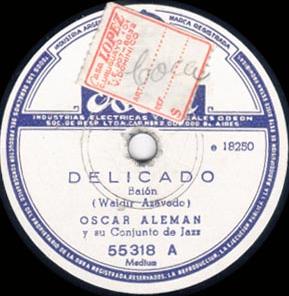
As mentioned above, countless versions of "Delicado" have been recorded since the release of the original in 1951 - one of my favorites is the guitar rendition by Oscar Alemán y su Conjunto from October 1951, a tribute from a master, who started his career playing the cavaquinho in the streets of Santos and ended up one of the best guitarists ever. Unfortunately, there is no filmed evidence of Alemán's incredible rendition of "Delicado", however, other guitarists have also transcribed the tune in a convincing arrangement - here's a contemporary example featuring a guitar quartet, Quarteto Abayomi, performing the tune straight:

I wish you a Happy New Year 2009/Feliz Ano Novo 2009!
Jo

Seasons Greetings


I want to thanks the readers of this blog for sharing interest in the Brazilian choro, I'll continue posting new blogentries in 2009, but no longer on a weekly basis, as I have other obligations to take care of. The blog has had weekly entries since August 2006 and has by now reached a number of 180+ entries since then. It takes time to do proper research, I am not an expert, just a curious investigator interested in sharing my limited knowledge on the subject with other people, who may have a similar interest in choro. Anyway, if my small contributions have helped people to open their senses for one of the world's most beautiful and fascinating music traditions, I'm happy and content. - I wish you all a Merry X-mas and a Happy New Year!

One of my first encounters with the Brazilian violão as played by a contemporary and highly estimated artist was through listening to some of the released recordings by Carlos Barbosa-Lima, who recorded several outstanding solo-albums for the American Concord label during the 1980s. - Carlos Barbosa-Lima (b.1944) is a native Brazilian, who began studying the guitar when he was seven . Among his teachers were the influential Brazilian guitarist Isaias Savio and further Andres Segovia. While still a child, he was performing in public and he made his recording debut when he was just 12. He first toured the United States in 1967 and during 1971-72 Barbosa-Lima performed in London and New York, gaining a worldwide reputation. He lived in New York for quite a few years before settling in Puerto Rico. Carlos Barbosa-Lima's tasteful yet virtuosic control of the guitar has resulted in consistently delightful solo recitals that appeal to a wide audience. His releases have found him exploring the music of Antonio Carlos Jobim, George Gershwin, Scott Joplin, Luiz Bonfa, Cole Porter, Leonard Bernstein (songs from West Side Story) and a variety of lesser known Brazilian composers.(info excerpted from AMG)

I found several uploaded videos at YouTube featuring Carlos Barbosa-Lima, I insert some examples below to share these highly enjoyable renditions of classic choro pieces by a master of the violão, who knows his roots. - Here's a rendition of "Tico tico no fúba" from a live-performance with accompaniement by a ukulele player!


Here's a solo recital of Nazareth's "Odeon":

Finally, here's Carlos Barbosa-Lima's terrific solo recital of Pixinguinha's "Um a zero" from a live performance - enjoy!

---

Stay tuned, best wishes for the seasons holidays!

Jo

Yamandú Costa - Wizard of The Violão de 7 Cordas

One of the highlights in Mika Kaurismäki's 2005 documentary film on choro in Rio, 'Brasileirinho', is the scene with Yamandú Costa playing Pixinguinha's 'Carinhoso' alone on stage fronting an audience of hundreds of people spellbound by Yamandú's engaging stage appearance and little by little joining in singing Braguinha's lyrics and thus making the performance a mutual experience - a true spiritual community tied together by the magic of Yamandú's guitar, exposing the soul of choro to the spectator of the film.


Yamandú's stage appearance is pure magic , a spontaneous explosion of aristic vitality that is not often seen in entertainment nowadays where every step and lift of an eybrow by the performer on stage seems to be studied in advance and a conscientious gimmick applied to gain the wanted success. Not the issue regarding Yamandú - the magic is a natural effect of the simple fact that he is an authentic artist, not just another pretender. This does not mean, however, that Yamandú does not do work-out to gain success during performance, of course he does - but his stage appearance comes naturally from the heart and soul of a true artist, I'm convinced.

Yamandú Costa (b.1980) is from Passo Fundo in the Southern part of Brazil and he started to study the violão at seven years of age with his father, Algacir Costa, leader of the group Os Fronteiriços, and he mastered the instrument after studying under Lúcio Yanel, an Argentine virtuoso rooted in Brazil. At fifteen he studied the folk music of Southern Brazil, Argentina and Uruguay. After hearing Radamés Gnattali, he began to study the music of other Brazilians, such as Baden Powell de Aquino, Tom Jobim and Raphael Rabello. At seventeen he played in São Paulo for the first time and he was soon to be recognized as the musician to revive Brazilian guitar music. At that time Yamandú had decided to make the violão de 7 cordas his main instrument, and he has since evolved as a true virtosic master of this Brazilian instrument, both as a soloist and as an accompanist. He has performed together with the cream of Brazilian MPB artists, leads his own trio and has toured worldwide besides recording, composing and arranging. Learn more about his career from the official website, click here

The shown cd by Yamandú Costa,'Mafuá', has been released recently by the German label Acoustic Music and this is the first cd fully devoted to Yamandú's skills as a composer and soloist. The cd has 13 tracks of music composed, arranged and played by Yamandú on the violão de 7 cordas, a tour-de-force exposing his virtuosic skills as a performer of different styles, but all with a touch of genius that is his very own. You can hear elements of choro, samba, bossa and Argentine roots music mixed with inspiration from Bach and even the flamenco tradition. The title tune, 'Mafuá' (- meaning 'shambles' in English), is a choro that shows off Yamadú's mastering of the genre in a convincing and engaging performance of the tune. Other titles, like i.e. 'El negro del blanco' mixes elements of Argentine roots music (chammamé and milonga) with Brazilian elements applying a breathtaking technique that borrows from both flamenco and gaucho tradition, also present in the last track on the cd, 'Tipo bicho'. Tunes like 'Samba pro Rafa' and 'Bostempornea' pay tribute to the inspiration from Raphael Rabello and Baden Powell, and you'll probably detect other influences as well when listening to the cd. Do not hesitate to get a copy of this fabulous album, which may rank as the record of the year 2008, if you like high quality guitar music. Definitely recommended! - Learn more about tracklist and listen to audioclips clicking here

YouTube has several upoloaded videos featuring Yamandú Costa, I found a lengthy excerpt of a recorded live-performance in Tel Aviv, Israel, from November this year. Yamandú plays three tunes, the first is a part of 'Bachbaridade', the next is the title tune of the mentioned cd, 'Mafuá' and finally you'll have a rendition of Nazareth's 'Breijeiro' - enjoy Yamandú in action!

---

This blogpost will be the last on a regular weekly basis in 2008, from 2009 I've decided to post only once in a while.

Jo

'Edinho no choro'

Recently I was pointed to a recording that seems to be a pioneer recording of the electric guitar used in choro. I got curious and searched the online discoteque at Instituo Moreira Salles hoping to find the recording there and having the possibility of listening to it. I was lucky, I found the record searching the title stated in headline above. If you are unfamilar with the search facility at Instituto Moreira Salles, you have the possibility to listen to 'Edinho no choro' by clicking here or headline - the musicplayer available at Instituto Moreira Salles opens in a new window and then you can listen to the streaming audio after it has loaded.

'Edinho no choro' was released on a Continental 78 rpm in 1945 (Continental, 15.337) and it is performed by Pereira Filho playing the electric guitar accompanied by his Conjunto. Comparing the recording with recordings of the electric guitar from the same time made in the USA or Europe the sound of the instrument is rough and distorted in certain sequences caused by problems with an adequate volume control during recording, anyway, a lot of early recordings of the electric guitar suffer from the same problem, refining of pick-ups at the guitar, amplifiers and recording equipment had to wait another decade to be solved sufficiently. Never mind, the recording of 'Edinho no choro' is a valuable historical document of the electric guitar used in choro, especially considering the fact that choro traditionally has been performed using acoustic instruments only. Of course, there are other early examples of an electric instrument used in choro - i.e. Garoto (Anibal Augusto Sardinha) made recordings of choro and related music 1943 playing the electric lap steel guitar accompanied by pianist Carolina Cardoso de Menezes (- like in the USA the electric lap steel guitar seems to have been the first electric string instrument used in Brazil).

No photo and not much info available on the main performer of 'Edinho no choro', however, here is an English summary of the profile in Dictonário Cravo Albin - the main source in Portuguese about Brazilian MPB artists.

Pereira Filho (João Pereira Filho) (1914-1986) was born in Rio de Jaineiro as a son of a professor of the violão, João Pereira. Already as a kid of 4 years of age he started playing the cavaquinho and he had bandolim lessons with his father even before he could read. While at primary school he formed small conjuntos with his school mates and performed at private parties, soon deciding to study the violão as his main instrument. At 11 years of age he participated in a festival promoted by Istituto Nacional de Música and soon after he was featured in a spectacle at Teatro Lírico, "Reisados e cheganças", promoted by the city Hall of the City of Rio de Janeiro. He composed his first piece for solo violão,"Variações sobre cateretê", in 1929, and in 1930 he became a member of Orquestra de Napoleão Tavares. In 1932, he joined Orquestra de Ioiô, where he stayed as a member the following eight years. In 1933, he recorded his first solo record for Victor of his own compositions, "Jongo africano" and the waltz "Áurea". In 1936, he recorded "Variações sobre cateretê" for Victor, and in 1937 he recorded the samba canção, "Tua partida", together with Mário Morais and vocal by Francisco Alves, also for Victor. - In 1941, Pereira Filho formed his own Conjunto. In 1944, he accompanied singers Dircinha Batista and Déo in two recordings, and in 1945 he recorded "Edinho no choro" for Continental. In 1951, Pereira Filho e seu Conjunto accompanied Pedro Raimundo in five recordings for the Todamérica label, and in 1953 Pereira Filho recorded his own "Conversa fiada" and "Serenata havaiana" for Todamérica. Accompanied by his Conjunto he also recorded the bolero "Garoa" and the dobrado "Borba gato" for Continental the same year. In 1959, Pereira Filho recorded his own "Noite sem rumo" for Todamérica, which seems to be his last solo recording.
---
Jo