Radamés Gnattali

Radamés Gnattali (1906-1988) is a fundamental name in Brazilian music. A classically trained composer, conductor, orchestrator, and arranger, he worked for a living in the popular side of the business, deeply influencing Brazilian popular music with his arrangements and conceptions. His compositions, both in the erudite and popular fields, concurred to bridge the gap between the two idioms, a self-imposed task that was always kept in sight throughout his whole life.
Gnattali was known as a talented arranger and was hired by many of the best popular musicians and radio stations to produce arrangements, including some of the first arrangements of Brazilian popular music for symphony orchestra. He embraced the sound of Glenn Miller and American swing and jazz and added American jazz harmonies to his sophisticated arrangements, to the disgust of hard-line nationalist critics. He worked as an arranger for radio for thirty years and later for TV Globo. Gnattali's work expanded the scope of Brazilian popular music, through his work he added legitimacy to instrumental popular music such as choro.


A career profile by Alvaro Neder available at AMG


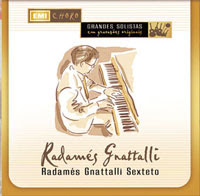
As an example of Gnattali's work as an arranger, composer and instrumentalist I recently found a cd by Radamés Gnattali Sexteto on EMI, Brasil (CD 5936302), containing 8 tracks of recordings by this unit, shown below.


The music on the cd has compositions in the great tradition of choro (track 1-4 and 7), two tracks are devoted to compositions by Gnattali displaying his conception of a cross over between erudite and popular, one of them beeing a short homage to another renown Brazilian composer, Tom Jobim. The other composition by Gnattali is his 'Divertimento para seis instrumentos' written for this performing group. - I think this recording is interesting and highly recommended as an example of how classic choro is combined with a modern conception of harmony, the performance in all 8 track is seamless by all involved, both the sextet and the overdubbed strings. Some of the arrangements had me thinking of a Brazilian autentic issue of be bop, others - like the arrangement of "1 X 0" by Pixinguinha - left me with a feeling of listening to ragtime, both experiences incorporated in a great fascination with the music on this cd. Recommended, definitely.Tracklist and info on personnel inserted below.

1. 1 x 0 (Benedito Lacerda - Pixinguinha), 2. Cochichando (Alberto Ribeiro - Pixinguinha - João de Barro), 3. Urubu Malandro (Louro - João de Barro), 4. Sofres Porque Queres (Benedito Lacerda - Pixinguinha), 5. Meu Amigo Tom Jobim (Radamés Gnattali), 6. Nova Ilusão (José Menezes - Luiz Bittencourt), 7. Por um Beijo (Terna Saudade) (Anacleto de Medeiros - Catullo da Paixão Cearense), 8. Divertimento para Seis Instrumentos (Radamés Gnattali)

Personnel: Chiquinho do Acordeon: accordion, Laércio de Freitas: piano, Luciano Perrone: drums, Radamés Gnattali: piano, Pedro Vidal Ramos: bass, Zé Menezes: el-guitar. All arrangements by Radamés Gnattali.

I found a video performance on YouTube of two piano compositions by Gnattali, performed by classical piano player Marc-Andre Hamelin.


Raul de Barros

Raul de Barros (Raul de Machado de Barros, b.1915) is considered one of the great Brazilian trombone players. He began his career in 1935 playing in neighborhood and suburban clubs in Rio de Janeiro and later in dance halls.

In 1948 he released his first solo record interpreting on the trombone the choros 'O pobre vive de teimoso' and 'Malabarista', by Donga. In 1949 he released his famous choro 'Na Glória' played solo on the trombone. He performed actively on Nacional Radio programs in the 1950s. He performed in Uruguay and Argentina. In 1955 he and Dilermano Pinheiro released the album 'Trombone zangado'. In 1958, he recorded the album 'Ginga de gafieira'.

In 1966 he was part of the Brazilian delegation to the Black Art Festival in Dakar, Senegal alongside Clementina de Jesus, Ataulfo Alves, Paulinho da Viola and Elton Medeiros, among others. He recorded a solo album in 1974 'Brasil, trombone' which has been released on a cd by EMI/Brasil, shown below.


In 1979 he released the record 'O som da gafieira'. In the album 'O trombone de ouro' recorded in 1983 he interpreted classics such as 'Carinhoso', by Pixinguinha, 'Pedacinhos do céu', by Waldir Azevedo and 'Ela disse-me assim', by Lupicínio Rodrigues. He worked with names such as Ary Barroso, Pixinguinha and Radamés Gnatalli. He played in several orchestras among them Copacabana Palace. After a long time away from the stage, he returned to perform in public in 2004.
I found a bigband performance on YouTube of Raul de Barros' composition 'Na Glória'


Jo

Roda do Choro


It is inevitable: Jacob do Bandolim passes by now and then; no wonder, as I think his music and compostions are great.


This time I found him on a 1960s LP titled Na Ronda Do Choro. The album contains 12 tunes by Jacob do Bandolim and his conjuncto.

Jacob do Bandolim was born as Jacob Pick Bittencourt in 1918 in Rio de Janeiro and passed away in 1969. He became the most famous bandolim player and composer of the past century. He composed 103 compositions that became the standard repertoire for the instrument. One of his most famous tunes he wrote in 1957 is titled Noites cariocas, which is on the LP too.

The title of the album, Na Roda do Choro, refers to the traditional social and musical gatherings that belong to the choro tradition. Musicians and fans come together and sit in a ring and make music. The young musicians learn that way how to play the choro music from the eldery and more skilled musicans. This is called a Roda do Choro.

I found such a Roda do Choro, where you can see how choro music used to be played. It is a fragment of the tune Vibracoes, composed by Jacob do Bandolim and played by the Sexteto Foltia Seca. The musicians are sitting in a circle. Enjoy the fragment.


Thanks Jo for pointing me to this interesting album.

Keep swinging

Hans Koert

keepswinging@live.nl

75: 27 January 1932: Toy Time - Aesop Fables Cartoon
All Of Me -405133 - Louis Armstrong and his Orchestra


This contribution is also posted at the Keep swinging web log.


<>

Dino Sete Cordas

Horondino José da Silva (1918-2006), known as Dino Sete Cordas, was a famous musician and quite an institution on the popular Brazilian music scene. Dino Sete Cordas was the developer of the seven-string guitar style. In more than 70 years of active and uninterrupted professional activity, he accompanied uncountable important artists from several different generations and styles, arranging and orchestrating for recordings as well.
Alvaro Neder writes a career profile in AMG, quoted below:
"Son of an amateur violonista (Brazilian acoustic guitarist) and having also two brothers influenced by music (Lino, cavaquinho, and Jorginho, a percussionist who later worked with the renowned Época de Ouro), Cordas began to play in seresta groups at 14. Cordas became a professional in 1935, accompanying the singer Augusto Calheiros, who used to perform in circuses. At that time Cordas was already developing his style, which is based on melodic and quick basslines (baixarias). In 1937, Ney Orestes, then violonista of the famous Regional de Benedito Lacerda, became ill, and Cordas subbed for him. Upon Orestes' death, Cordas became permanent in the group. With the substitution of the regional's other violonista Carlos Lentine by Meira (Jaime Florence), the duo Cordas-Meira, one of the most fruitful, famous, and long-lived of Brazilian popular music, was formed. The Regional de Benedito Lacerda accompanied many stars of the time, such as Carmen Miranda, Francisco Alves, Silvio Caldas, and Orlando Silva, among others. In 1950, the Regional de Benedito Lacerda was transformed into the Regional do Canhoto, and Cordas continued in the new group. After Tute retired, he added a seventh string (C) to his violão just like the pioneer did, enhancing the expressive power and stretching the possibilities of his baixarias. Meanwhile, the Regional do Canhoto continued in its successful career as accompanist for famous performers, in live performances and in radio and recordings.
The end of the '50s, with the inception of bossa nova, radically changed the taste of the masses concerning music. If choro performers could easily adapt their playing to suit sambas, sambas-canção, bolero, and other styles/genres, bossa nova was a completely different thing, and the later trend of Jovem Guarda (a teenybop style heavily influenced by British rock) would shut the doors of commercial music for remnants of the choro genre. Cordas adopted an electric guitar and joined Paulo Barcelos' group, specializing in dance parties and balls. Around 1965, the market began to welcome recordings of escolas de samba (samba schools). The sete cordas (seven-string violão) was again required. In 1965 and 1967, Cordas participated in the live recordings of the two LP's of the historic show Rosa de Ouro, by Hermínio Bello de Carvalho, with singers Clementina de Jesus and Aracy Cortes. At that time he was also playing with Jacó do Bandolim's Conjunto Época de Ouro. In 1970, the samba and the choro came up again, and Cordas returned to his busy schedule of recordings and live performances accompanying singers like Beth Carvalho, Gilberto Gil, Jards Macalé, Vinícius de Moraes, and Toquinho, among many others. In 1974 he arranged and conducted two important albums, the first solo one by Cartola, and A Música de Donga, in which the works of the important composer were recorded by Elizeth Cardoso, Paulo Tapajós and others, both released by the label specializing in musical history documentation Marcus Pereira. In 1976 Cordas orchestrated the second album by Cartola. In 1991, he recorded an important album with the late phenomenon Raphael Rabelo. Cordas continued to play samba and choro in several formations and venues."
I found a video homage to Dino Sete Cordas on YouTube. Enjoy!


K-Ximbinho


K-Ximbinho (Sebastião de Barros, 1917-1980) was a noted Brazilian reed player, composer and arranger. He was a member of Severino Araújo's Orquestra Tabajara, Fon-Fon's orchestra, Sete de Ouro, and the Orquestra Sinfônica Nacional (of Rádio MEC). As a composer, he was one of the most modern creators of the choro idiom, being a pioneer of its modernization with jazz and other rhythmic elements.

K-Ximbinho has several classic choros as part of the repertory of the rodas de choro (choro get-togethers), such as "Sonoroso" (recorded by the Orquestra Tabajara in 1946, as were "Sonhando" that same year, and "Sempre," in 1951). Also part of the repertory of the rodas de choro are his "Ternura," "Mais Uma Vez," and "Kachimbodega". His last composition, "Manda Brasa," won the choro contest II Festival Nacional do Choro/Carinhoso, in 1978. K-Ximbinho also had other significant compositions such as "Eu Quero É Sossego," "Saudades de um Clarinete," and "Gilka."


Saudades de Um Clarinete (LP,1980) (reissued on CD 2003 by Sony Brazil,278156) is the only release dedicated to K-Ximbinho's compositions, arrangements, conducting, and performance. The cd has big band arrangements as well as small combo readings of K-Ximbinho's compositions, displaying great performance by all involved. Tracklist and info on personnel inserted below.
Tracklist:
1. Eu Quero É Sossego; 2. Sempre; 3. Meiguice; 4. Tô Sempre Aí;5. Gilca; 6. Mais Uma Vez;7. Velhos Companheiros; 8. Penumbra; 9. Simoninha Na Barra; 10. Ternura; 11. Alto Plágio;12. Catita
Personnel:
K-Ximbinho (cl), Zé Bodega (cl, sax solo), Edson Antonio Marin (p), Edgar Nunes (dm), Antonio Augusto V. B. de Magalhães (b), Daudeth de Azevedo (cavachinho), Rafael Rabello (Violão de 7 Cordas), Jorginho (pandeiro), Jessé Sadoc (tb), Heraldo Reis (tp), Quinteto de Saxs: Dulcilando Pereira, Alberto Vianna Gonçalves, Ademir Gomes, Clóvis Timóteo Guimarães, Hélcio Jardim Brenha. Quinteto Villa-Lobos: Carlos Seabra Rato, Eros Martins de Melo, Paulo Sérgio dos Santos, Carlos Gomes de Oliveira, Airton Barbosa
Alvaro Neder writes a career profile in AMG:
He was interested in music early on and learned solfeggio, theory, and clarinet with a band master in his home town. In Natal, to where he moved with his family, he started to play with the amateur jazz band Pan Jazz. During his military service, he also took the saxophone and from 1938 to 1942, he was a member of the Severino Araújo's Orquestra Tabajara. In this latter year, he moved to Rio de Janeiro where he played with Fon-Fon's orchestra, having been the clarinet soloist on a recording of "Maria Helena" with Francisco Alves. In 1943, he became a member of the Napoleão Tavares orchestra. From 1945 to 1949, he joined again the Orquestra Tabajara. In 1946, the Orquestra recorded his classic choro "Sonoroso" (his first recorded composition). In 1949, he played in the orchestra for Rádio São Paulo. In Rio, he was hired by Avenida Dancing, and two years later by Rádio Nacional. From 1951 to 1954, he studied harmony and counterpoint with Hans Joachim Koellreutter and in 1954, he toured Europe. After his return, he worked as an arranger for Odeon and TV Globo (where he was the second alto in a section with masters Netinho, Biju, Walter Rosa, and Januário), also playing in other nightclubs like Sacha's. From 1965 to 1968, he was a member of the group Sete de Ouro, also having become a member of the Orquestra Sinfônica Nacional.
Jo